

Tazama Community Newsletter · Issue 2 · October 2026
Inside the conversations shaping safer instant payments.
Welcome to Issue 2 of the Tazama Community Newsletter. Issue 1 introduced Tazama 4.0.0. This issue looks at what happened when we took it to the people who run payment systems and fight scams.
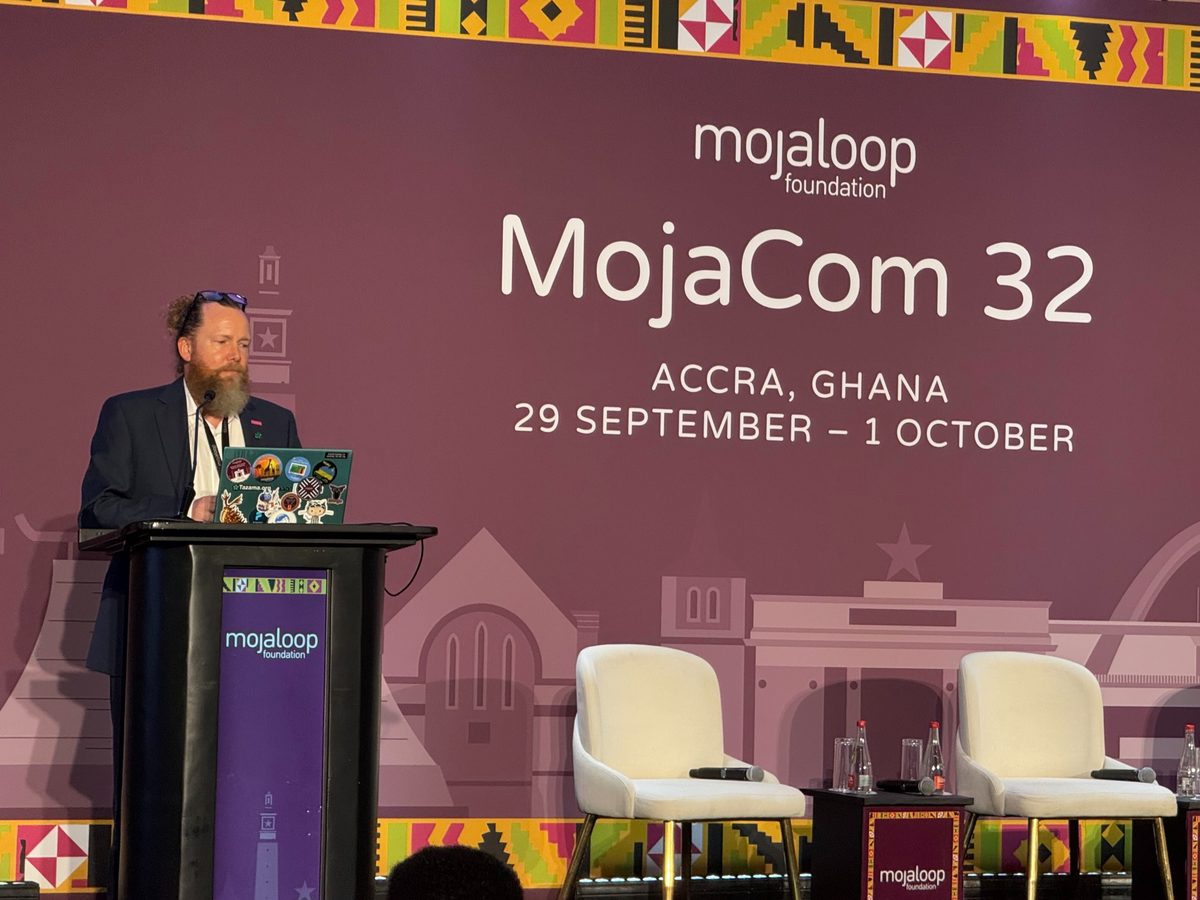
On September 30, Justus Ortlepp, Tazama’s Head of Product, presented Tazama 4.0.0 at MojaCom 32 in Accra, Ghana. The next day he joined the Global Anti-Scam Alliance’s Africa Chapter to discuss scams in South Africa. The two conversations kept returning to one question: how to make instant payments safer as they get faster and reach more people.
Tazama 4.0.0: From Release to Reality
Tazama 4.0.0 now has its own page on tazama.org. Send it to anyone evaluating Tazama. It shows what the platform gives a fraud team: a case system for investigators, a way to connect new data feeds without code, a place to build and test rules, and analytics that show whether detection is working. It also shows how your team can try the whole platform in an afternoon, with no license fee.
To see the platform working, watch the team demonstrate each component. For the thinking behind the release, read Justus’s piece, “A fraud system you can’t read is a fraud system you can’t defend”, on why 4.0.0 was built in the open with the people who run it. On the Tazama Page on LinkedIn, the “What’s new in Tazama 4.0.0” series goes through the release one component at a time.
Your team or your auditors can now see exactly how every Tazama rule reaches its decision. Read access to the rules’ source code is a short request away.
Tazama Around the World: From Deployment to Discovery
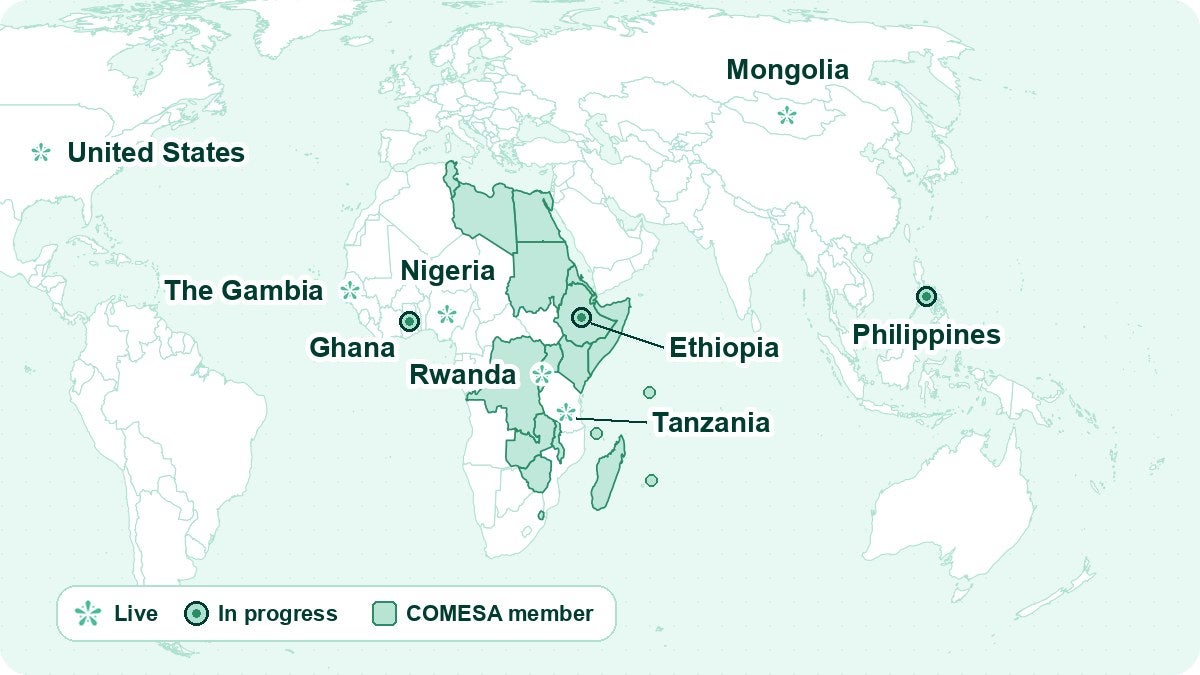
Since the launch, new conversations have opened with financial institutions, partners and payment system operators. As of October 2026, Tazama is live, in pilot or being tested at institutions across Africa, Asia and the Americas, each on its own payment infrastructure, under its own regulator and operating model.
11
live deployments
7
in development, moving to production
4
proofs of concept under way
10
proofs of concept committed
Here is some of what is happening around the world.
- In Ghana, a shared instant payment switch planned for savings and loans companies, microfinance institutions and credit unions will include Tazama for real-time fraud monitoring. Procurement is under way.
- In Ethiopia and the Philippines, two institutions are implementing Tazama with their own teams.
- Across Eastern and Southern Africa, the COMESA Clearing House, which runs cross-border settlement for the region, is preparing to deploy Tazama in eight COMESA member states, with Paysys Labs leading the work.
- In Nigeria, a leading bank runs Tazama in production.
- Mongolia has two live deployments, one of them a telco payment provider, and a live pilot.
- Tazama is also live in The Gambia, Tanzania and the United States.
Tazama at MojaCom 32, Accra
MojaCom 32 brought central bankers, payment hub operators and digital finance leaders to Accra from September 29 to October 1 to work on inclusive instant payment systems. In the general session, Justus presented “Tazama 4.0.0 – Full-featured fraud protection for those who need it most”. He walked through what the platform gives a fraud team, and how much of Tazama 4.0.0 was shaped by the requirements of the COMESA Clearing House’s upcoming deployment. He opened by picking up the “moments of yes” the conference had been talking about: “Fraud in instant payments can turn a moment of yes into a moment of oh no at the speed of thought.”
Michelle Semple, Tazama’s Head of Growth, was also in Accra. Away from the main stage, the team’s one-to-one meetings kept coming back to two points. The first is timing: fraud monitoring is best built into a new instant payment system at the same time as the switch, because operators rarely go back and add it later. The second is cost: a business case helps central banks and operators weigh fraud prevention against its price, and the payback period can often be as little as six months, with money saved from then on. “Tazama is being mentioned and used more than ever,” Michelle said. “But installing a payment system without ensuring trust doesn’t lead to an inclusive payment system that people adopt.”
As Payments Accelerate, Fraud Must Keep Pace
An instant payment settles in seconds. Once the money has moved on from the first receiving account, getting it back is much harder. A check that runs while the payment is being made can hold it for review before the money moves on.
A single bank sees its own customers’ payments. Where payment infrastructure has visibility across transactions between institutions, it can help identify patterns that may not be visible to a single institution, such as one account collecting from customers of several other banks. Banks and the payment system working together can see more of the pattern than either can alone.
GASA Africa Chapter: From Insight to Action
On October 1, Justus joined the Global Anti-Scam Alliance‘s Africa Chapter to discuss its State of Scams in South Africa 2026 report, with Caroline Mampuru of SABRIC, Ursula Pearson-Williams of PayInc, Professor Julie Reid of UNISA, Poppy Kweyama of the National Consumer Commission and Patricia Eromosele of GASA.
1,280
South African adults surveyed
85%
said they were confident they could recognize a scam
54%
had interacted with a scammer
6%
reported a scam to the authorities
Feeling able to spot a scam didn’t stop people engaging with one, and very few reported a scam to the authorities.
Asked which single policy change would make the biggest difference, Justus said it was hard to pick just one. A scam victim is often sent to the police to open a case and then back to their bank, and no single policy joins those steps up. He proposed three measures to join them:
- Make fraud detection a mandatory capability of the payment system. Not every bank, mobile money operator or remittance agent has it built in, and few are required to meet a standard as strict as the one for anti-money laundering.
- Give every sector a scam passes through a duty of care, as Singapore’s Shared Responsibility Framework does for banks and telecommunications companies.
- Build a national center for scam intelligence and response, like Australia’s National Anti-Scam Centre. The Global Signal Exchange does the same across borders.
He described the response to scams as a cliff edge. One version of “prevention is better than cure” says a sign at the top of a cliff, warning people about the drop, does far more good than an ambulance parked at the bottom. With scams, the sign at the top is education and warnings, but people who feel confident they can spot a scam still engage with one. By the time someone is about to pay a scammer, those warnings have already failed, and at the bottom of the cliff, recovery by the bank and the police rarely gets the money back. Tazama works in between, checking the payment in the split second before it settles. “We are trying to catch that person halfway on their journey to the bottom before the ambulance picks them up,” he said. No single part of the response is enough on its own, so every part has to work together.
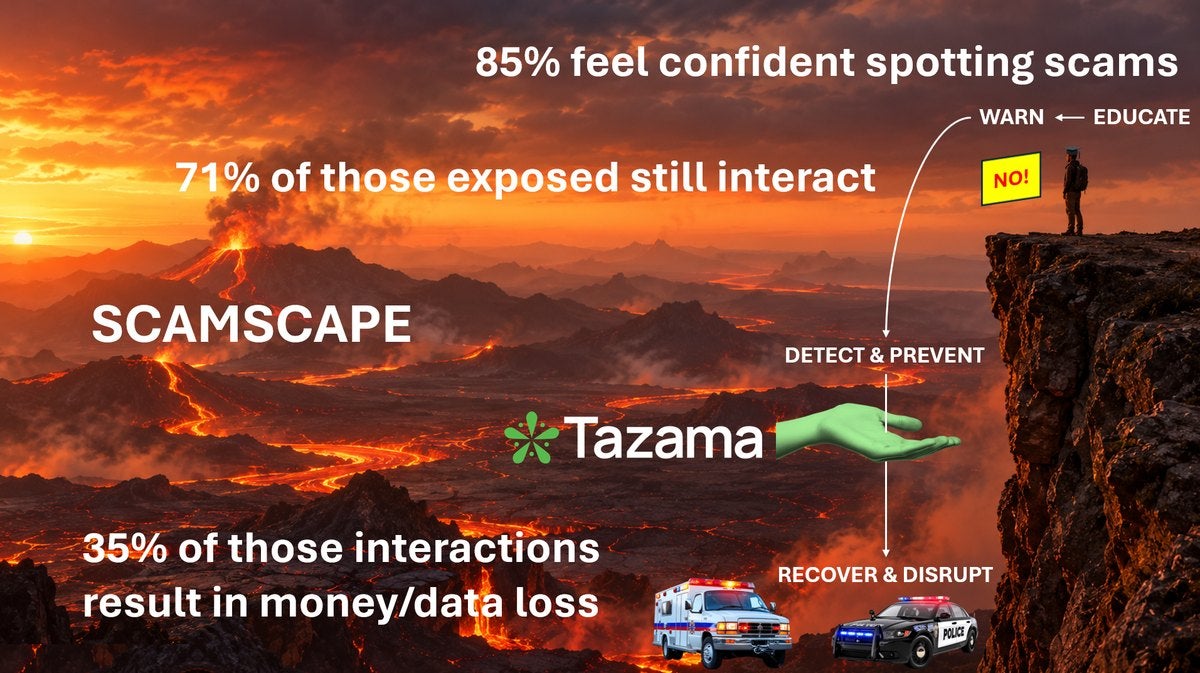
Justus’s “scamscape”: education and warnings at the clifftop, Tazama catching people on the way down, recovery at the bottom.
Justus sets out the argument in full in “Scam victims rarely speak up, so the payment system has to” on tazama.org.
Sharing Defenses Across Borders
Scammers share techniques across borders faster than institutions share their defenses, and what one country’s banks and payment systems learn about a scam rarely reaches the next country. That is why Tazama and other organizations are working on something new: a cross-border alliance where financial institutions, payment operators, regulators and law enforcement describe fraud and scams in the same terms and share what they see, with Tazama putting that shared knowledge to work in real-time detection. We’re calling it the Open Financial Trust Alliance (OFTA), with more to share ahead of its launch. Tazama’s partnership with the Global Signal Exchange, which pools scam signals across industries to disrupt criminal networks, is an essential part of that work.
Ecosystem in Action: Building Together
Organizations are implementing Tazama and contributing to the code. Here are two examples.
Implementation showcase: Rwanda
Rwanda’s national payment switch, RSwitch, completed its first Tazama implementation in 2025, working with integration partner WiredIn and alongside Mojaloop’s open-source instant payment software. The RSwitch deployment gives other switch operators running Mojaloop a working national example to learn from.
Community contribution: a standard way to install Tazama
A working group of Tazama’s Technical Steering Committee, with contributors from several organizations, is building a standard, maintained way to install Tazama in an institution’s own cloud (a Helm chart for Kubernetes). It means less custom engineering between a successful trial and a system in production, for every institution that uses it. The work is in progress, and the group publishes its minutes on GitHub.
Running Tazama, testing it, or building on it? Tell us on Slack and your story could be in the next issue.
The Road Ahead
- Product: proposals before the Technical Steering Committee include letting Case Management tell fraud alerts from money-laundering alerts automatically, so investigators no longer classify each alert by hand.
- Community: the Technical Steering Committee, which decides what Tazama builds next, meets every two weeks, and anyone can join, including institutions that want a say in the roadmap. The next two meetings are October 8 and October 22 at 15:00 UTC, on the Tazama meeting calendar.
- Events: SIIPS 2026, AfricaNenda’s conference on inclusive instant payment systems in Africa, runs November 18 to 20 in Mauritius. Collin Moleleki will be there.
- Issue 3 of this newsletter arrives in early December.
The Journey Continues
Explore Tazama, join the community, contribute to the project, or connect with the ecosystem to discover how you can participate.
- Website: www.tazama.org
- GitHub: github.com/tazama-lf
- Slack: Join the Tazama Community
- LinkedIn: Follow the Tazama Page on LinkedIn
- Become a partner: tazama.org/partner
- Past issues: tazama.org/news/newsletter
Thank you for being part of the Tazama community.
The Tazama Team
Tazama is an open-source project hosted by the Linux Foundation, with support from the Gates Foundation.
Tazama.org | Open-Source Transaction Monitoring Software supporting Inclusive Instant Payments System