

Tazama checks every payment that passes through a national switch or instant payment system in real time, before the money leaves the payer’s account, and flags the ones that look like fraud. It’s free, open-source software you run on your own infrastructure.
Tazama is hosted by the Linux Foundation, with support from the Gates Foundation, and is a recognized Digital Public Good. Version 4.0.0 adds case management, a no-code way to connect new data feeds, a rule builder with testing, and fraud analytics.
See Tazama 4.0.0Ask the community
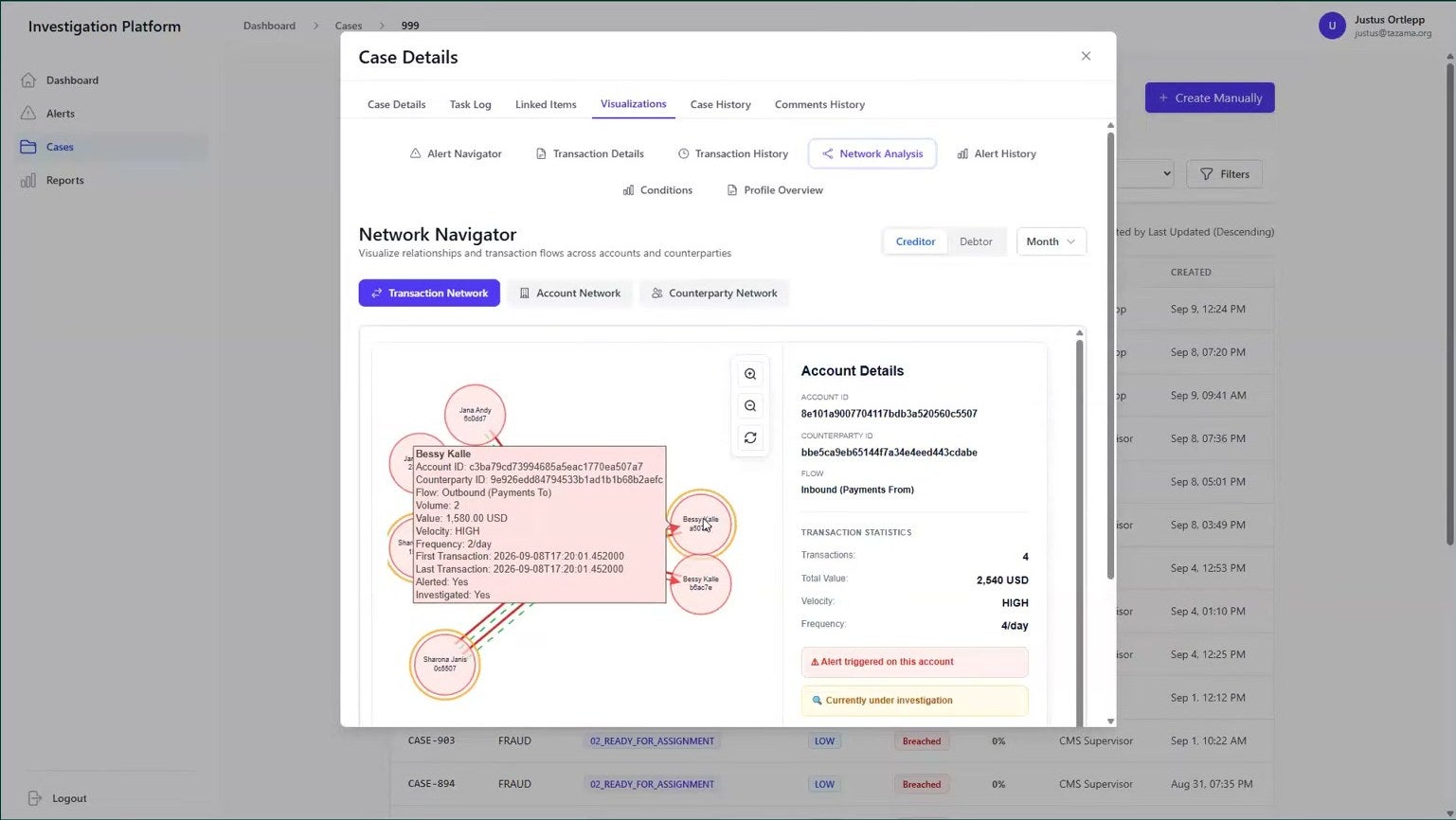
Case management in Tazama 4.0.0: every alert lands in a queue, becomes a case, and closes with an audit trail.
Apache 2.0
No license fee, no vendor lock-in. Source
Your infrastructure
On-premises or your own cloud, so payment data stays where you keep it
ISO 20022
pacs.008, pacs.002, pain.001 and pain.013, plus any other feed you map
In production
Eleven institutions run Tazama, among them RSwitch in Rwanda
What a switch gets
Fraud detection at the center of the payment system
A switch sees transactions that no single bank can. Running detection there lets you stop a fraudulent payment before it settles, and gives every participant the same protection, including the smallest.
See fraud that crosses banks
Watch payments from all your participants in one place, so money moved through several banks shows up as one pattern instead of fragments in each bank’s own system.
Explain every alert
Detection runs on rules and typologies you can read. Each alert arrives with its score and the reason it fired, so you can tell a participant, a customer or a supervisor why a payment was flagged.
Change rules without downtime
Push a new rule or threshold while payments keep flowing. There’s no maintenance window.
Test before you go live
Run a new rule against past transactions in Rule Studio and see what it would have flagged before it touches live traffic.
Investigate in the same platform
Your fraud team takes an alert to a closed case in Tazama, with a filed SAR or STR attached and an audit trail of every decision.
Monitor more than card and bank payments
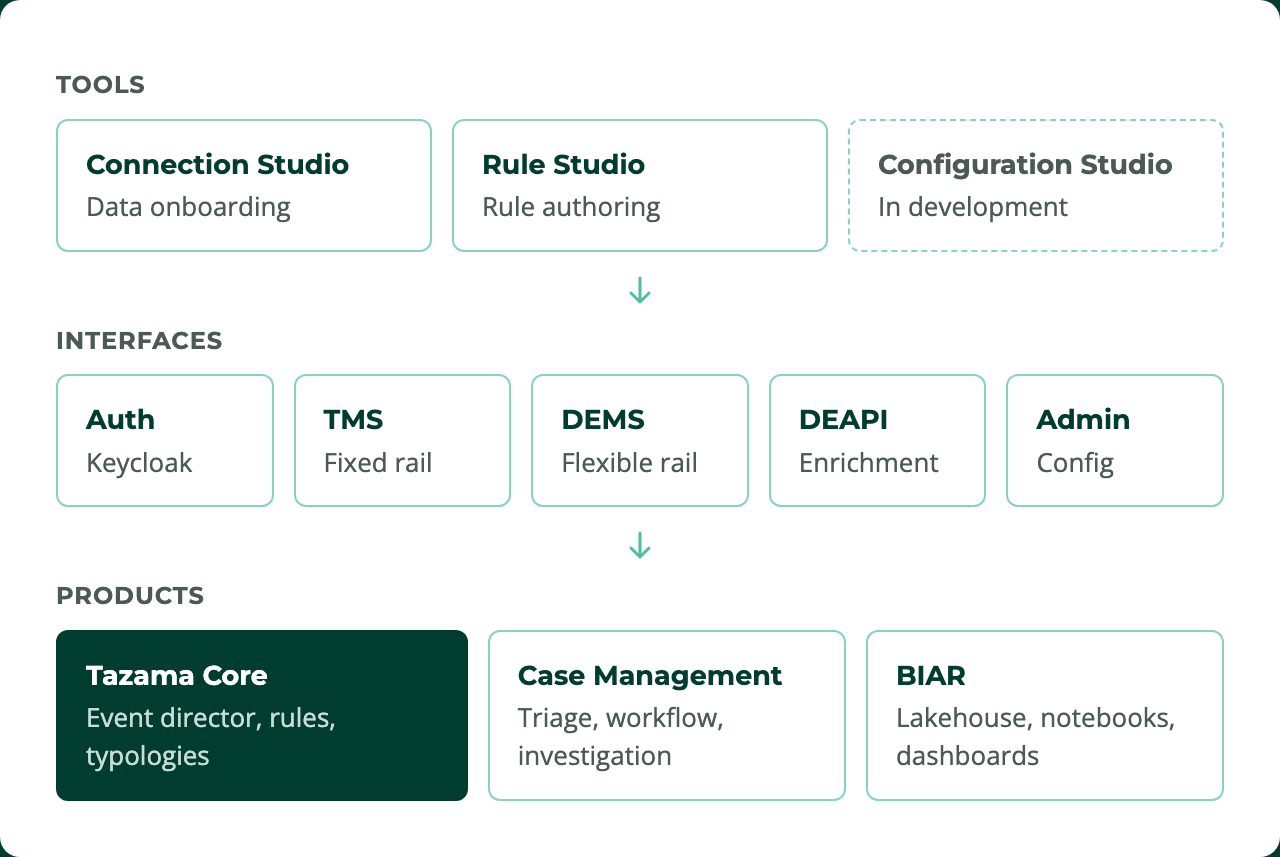
Map mobile money, agent or other feeds in Connection Studio, without code, and run them through the same detection.
How it works
Rules and typologies you set, scored on every payment
Each payment message is evaluated by rule processors, each checking one behavior, such as how new the receiving account is or a transfer far larger than the sender usually makes. Typologies combine those results into a score against thresholds you set, and payments over the line raise an alert.
Tazama ships 33 ready-built rule processors. Your analysts add their own in Rule Studio, and the calibration notebook suggests where thresholds should sit from your own transaction history.
Questions
What switch operators ask first
Is Tazama free to use?
Yes. Tazama is open source under the Apache 2.0 license, with no license fee. You pay for the infrastructure you run it on and, if you want one, an implementation partner.
Can we run it on our own infrastructure?
Yes. You deploy Tazama yourself, on Kubernetes on-premises or in your own cloud account, with guides for AWS, Google Cloud and Azure linked from the Tazama stack. Transaction data stays in your environment.
Which payment messages does it read?
ISO 20022 as standard: pacs.008 and pacs.002 for clearing, and pain.001 and pain.013 for payment initiation. Other formats, such as mobile money transactions, are mapped in Connection Studio and run through the same detection.
Who can help us implement it?
Tazama works with implementation partners in Africa and Asia, listed in our announcements. The Tazama team can put you in touch with one that fits your market.
Where do we start?
Read what’s in Tazama 4.0.0, then run the evaluation stack on one machine to try it. Questions go to the community Slack or the Tazama team.
Evaluating fraud detection for your switch?
Talk to the Tazama team, or ask in the community Slack.
Contact Us